In the early stages of firmware development, every engineer faces a critical choice: Should the code run directly on the hardware (Bare-Metal), or should it utilize a Real-Time Operating System (RTOS)? This decision dictates the system's scalability, power consumption, and deterministic behavior.
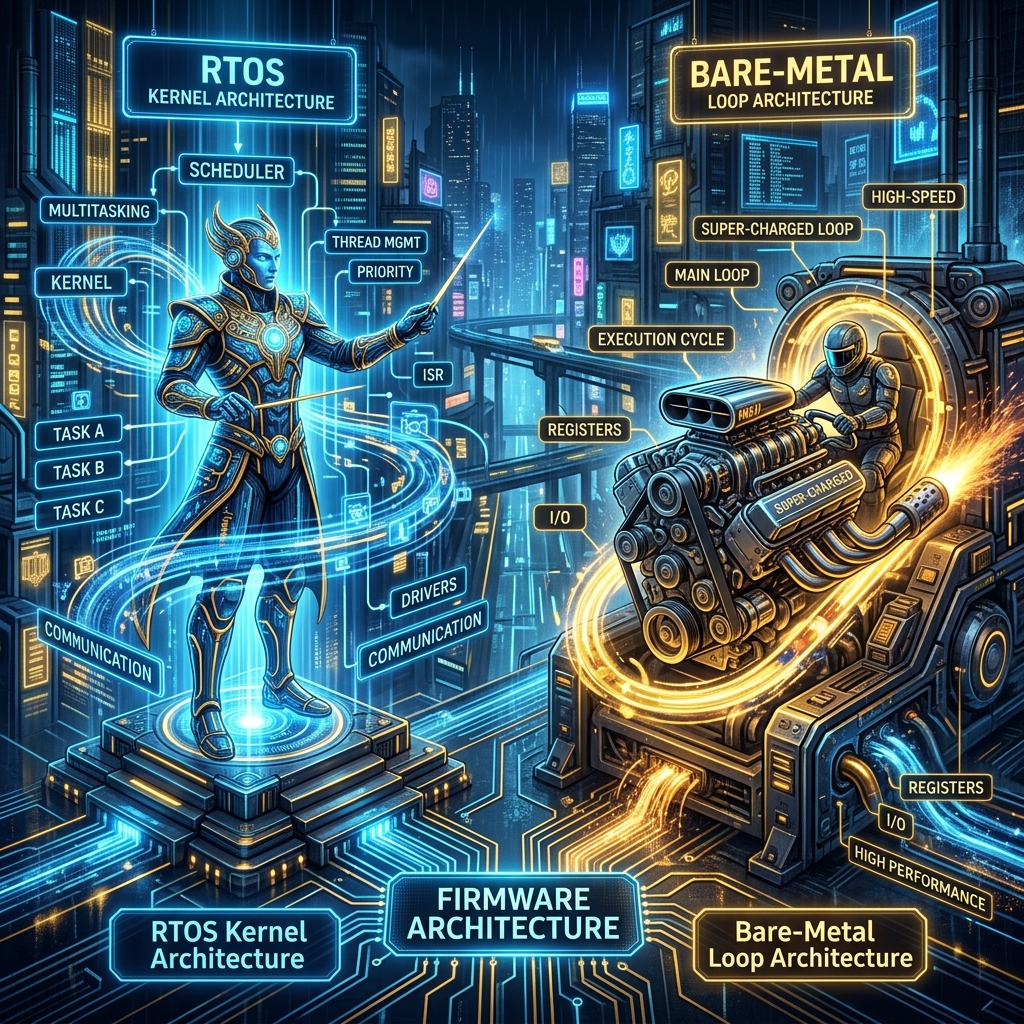
1. Bare-Metal: The "Super Loop" Approach
In a bare-metal system, your code typically consists of a single while(1) loop that executes tasks sequentially. Peripheral interactions are handled via interrupts (ISRs).
- Predictability: You have absolute control over every CPU cycle. There is no scheduler overhead.
- Resource Efficiency: Uses the absolute minimum RAM and Flash, as there is no OS kernel to store.
- Drawback: As the project grows (adding Wi-Fi, UI, and sensors), the super-loop becomes hard to maintain. A single blocking function can freeze the entire system.
2. RTOS: Multitasking and Concurrency
An RTOS introduces a Scheduler that manages multiple "Tasks" or "Threads." It provides primitives for task synchronization like Semaphores, Mutexes, and Queues.
Preemptive vs. Cooperative Multitasking
Most modern RTOSes (like FreeRTOS or Zephyr) use Preemptive Scheduling. This means a high-priority task can "preempt" (interrupt) a lower-priority task immediately, ensuring that time-critical logic (like motor control) is never delayed by background tasks (like logging).
Priority Inversion: The Silent Killer
A common pitfall in RTOS design is Priority Inversion, where a high-priority task is blocked by a low-priority task that holds a shared resource. We solve this using Priority Inheritance mechanisms built into the RTOS mutex primitives.
3. Feature Comparison
| Feature | Bare-Metal | RTOS |
|---|---|---|
| Context Switch | None | 1-10 microseconds |
| Modularity | Low (Spaghetti code risk) | High (Task isolation) |
| Real-time Performance | Excellent (for simple apps) | Excellent (if tuned) |
| Memory Overhead | ~0 KB | ~5 KB to 50 KB |
4. Popular RTOSes in 2026
- FreeRTOS: The industry standard for small MCUs (STM32, ESP32). Simple and portable.
- Zephyr Project: A modern, modular RTOS backed by the Linux Foundation. Features a massive driver ecosystem and built-in security.
- Azure RTOS (ThreadX): Known for its tiny footprint and pre-certification for safety-critical industries.
- RT-Thread: A popular open-source RTOS with a rich middleware ecosystem, especially for IoT.
Conclusion
At BM Embedded, we typically move to an RTOS the moment we introduce a network stack or a complex UI. The complexity of managing asynchronous network events while maintaining system responsiveness is almost impossible to do reliably in a bare-metal environment. However, for ultra-low-power sensors running on a coin cell, Bare-Metal remains the undisputed king of efficiency.