In the industrial world, every rotating machine—be it a motor, pump, or turbine—has a "heartbeat" in the form of vibration. By monitoring this heartbeat using high-frequency accelerometers and edge-based signal processing, we can predict mechanical failures weeks before they happen, saving millions in unplanned downtime.
1. Time Domain vs. Frequency Domain
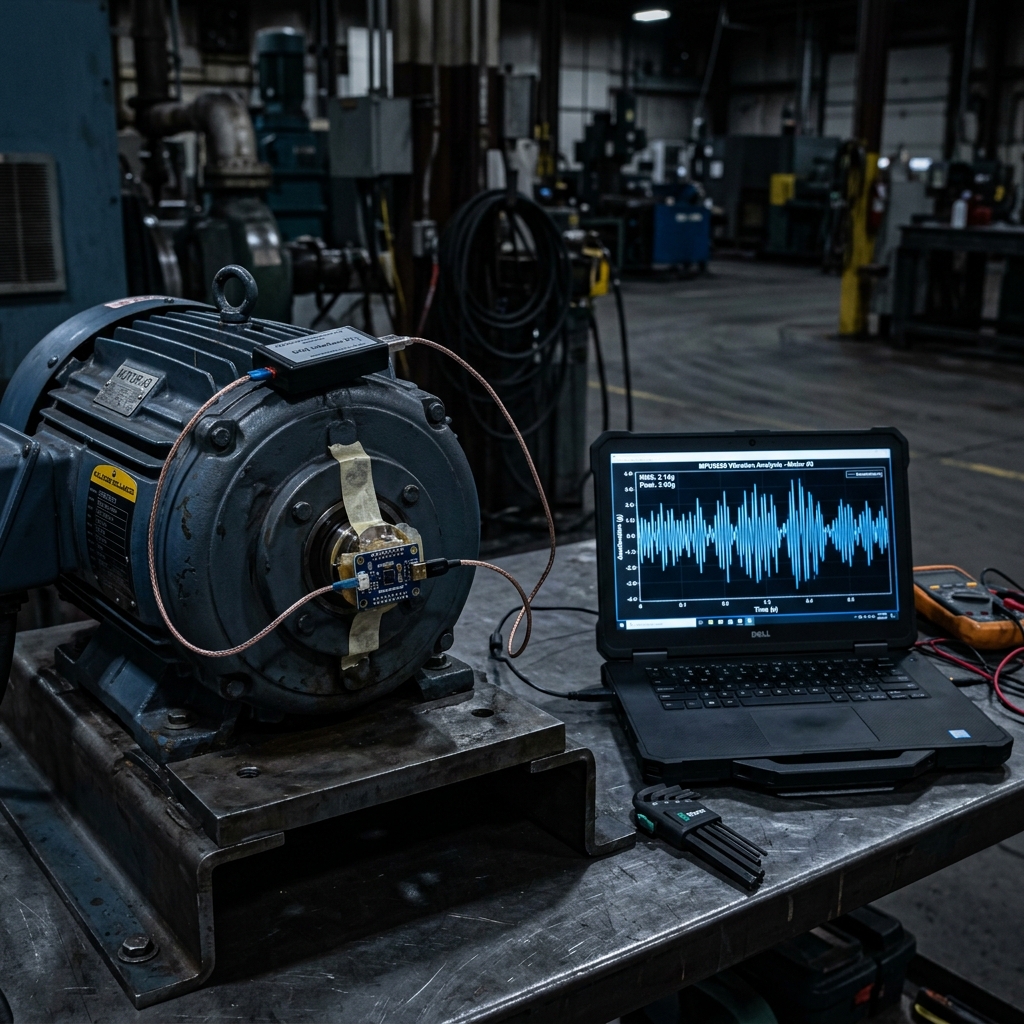
Raw vibration data comes in the Time Domain (acceleration over time). While this shows the overall intensity, it hides the specific cause of failure. By applying a Fast Fourier Transform (FFT), we convert the data into the Frequency Domain. In this view, every component (bearings, shafts, belts) appears as a distinct peak at a specific frequency.
2. envelope Analysis: Finding Bearing Defects
Bearing defects often produce tiny, high-frequency impacts that are buried under the much louder low-frequency vibration of the motor. We use Envelope Analysis (demodulation) to extract these impact signals. This allows us to detect "spalls" or cracks in the bearing race long before the bearing actually seizes.
"Vibration analysis is the science of listening to what the machine is trying to tell you."
3. Edge Computing: Reducing the Data Deluge
Sampling a 3-axis accelerometer at 10kHz generates 60,000 data points per second. Streaming this raw data to the cloud is expensive and unnecessary. Instead, we perform the FFT and anomaly detection directly on the Linux-based Edge Gateway. Only the processed "health scores" or critical alerts are sent to the central dashboard.
4. AI-Driven Anomaly Detection
Traditional systems use simple thresholds (e.g., "alert if vibration > 5mm/s"). However, a healthy machine might vibrate differently depending on its load or speed. We use Autoencoder Neural Networks (running on the edge) to learn the "normal" vibration profile of each specific motor. Anything that deviates from this learned baseline triggers an anomaly alert.
// Signal Processing on the Gateway
Vector data = read_accelerometer_fifo();
Vector spectrum = compute_fft(data);

// Check for specific fault frequencies
float bearing_health = monitor_band(spectrum, 1200.0, 1500.0);
if (bearing_health > ALARM_LIMIT) {
    publish_mqtt("motor1/status/critical", "Bearing Wear Detected");
}
5. Mounting Matters
The quality of your data is only as good as your sensor mounting. A loose sensor acts as a low-pass filter, killing the high-frequency data needed for bearing analysis. We always recommend Stud Mounting or high-stiffness industrial adhesives for the best results.
Conclusion
Predictive maintenance is no longer a luxury; it's a competitive necessity for modern manufacturing. By combining high-frequency sensing with sophisticated edge analysis, we help our clients move from "reactive" fixes to a truly "predictive" operation. At BM Embedded, we build the sensors and the intelligence that keeps industry moving.